Informational events
The project models systems in terms of events, records, and their relations, rather than treating observation as an external add-on.
Academic front door for the DAGI research program.
Whytics for applied and commercial workResearch on informational structure, higher-order dependence, and multiscale models across quantum systems and selected living-systems studies.
The DAGI Project develops and tests a research framework in which informational events, causal structure, and higher-order dependencies are treated as first-class objects of analysis. The work combines conceptual modeling with multiscale information decomposition and selected empirical validation studies.
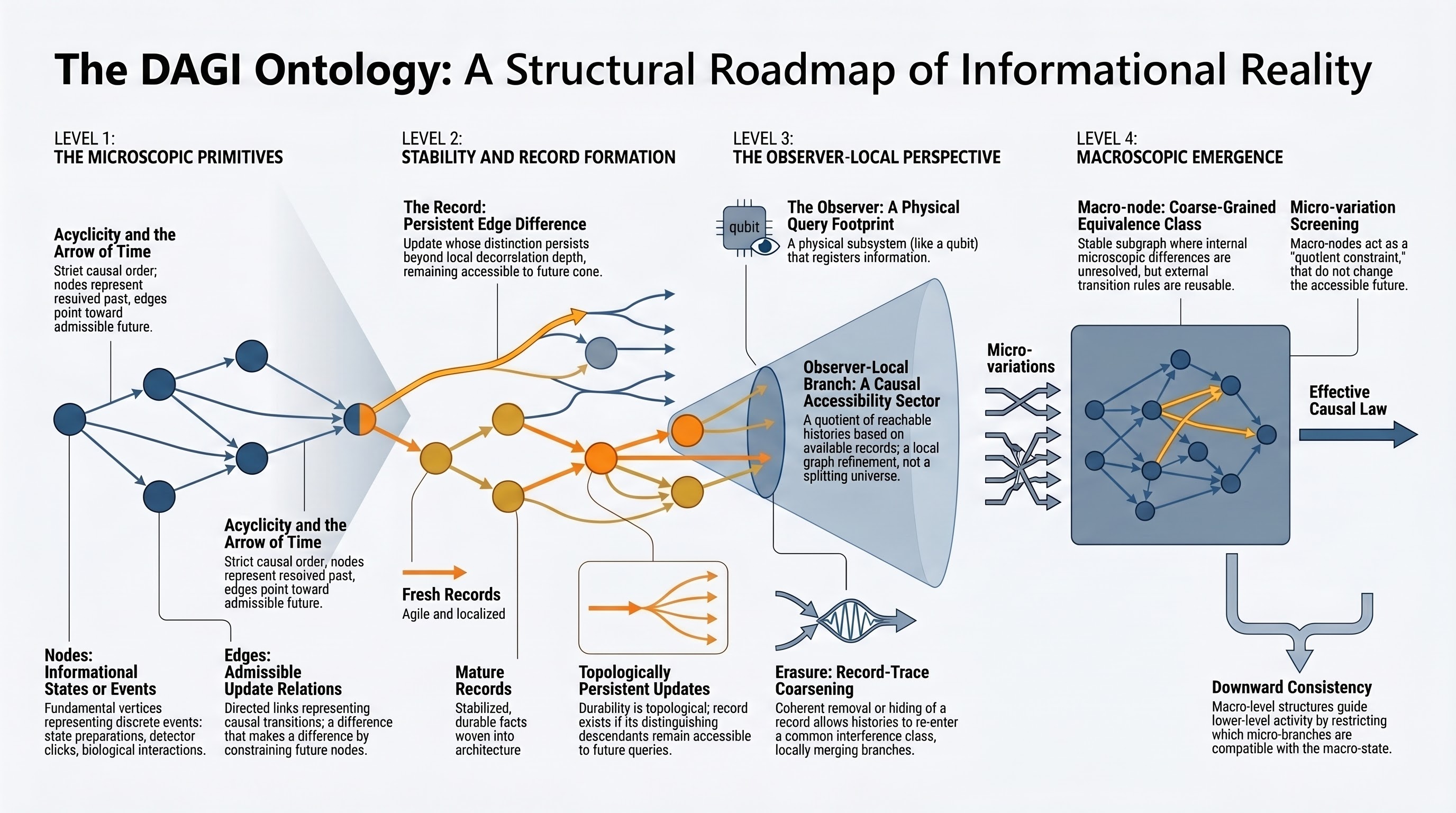
In the Directed Acyclic Graph Interpretation (DAGI), physical processes are represented as a single locally finite directed acyclic graph of informational states, records, and admissible updates. The structural roadmap below summarizes how microscopic primitives, persistent records, observer-local accessibility sectors, and macroscopic emergence fit together in that ontology.
Overview
The project asks whether complex phenomena can be described more clearly by combining two ideas:
Across different tracks, DAGI is used to study how structure appears across scales, how collective information can be decomposed, and how these tools behave in controlled quantum settings, simulation environments, and selected biological datasets.
Recent validation output related to higher-order structure in hardware benchmarks is now available on arXiv: arXiv:2603.20542.
Framework
DAGI is presented as an umbrella research program with two closely related strands: a foundational strand focused on informational events, records, branching, and observation, and a methodological strand focused on Möbius-based multiscale decomposition of lower- and higher-order informational structure.
Why the framing matters
The site distinguishes stronger and weaker claims clearly so foundational, methodological, validated, and exploratory work do not collapse into a single claim-cloud.
Core concepts
The project models systems in terms of events, records, and their relations, rather than treating observation as an external add-on.
Many systems cannot be understood from single variables or pairwise links alone. DAGI studies irreducible multi-part dependencies and collective organization.
A Möbius-based decomposition separates lower-order and higher-order informational contributions so genuinely collective structure can be studied explicitly.
Research tracks
Each track is presented according to its role in the program, from foundational work to empirical validation and exploratory extensions.
DAGI explores DAG-based descriptions of informational states, records, branching, decoherence, and quantum erasure to make measurement and observer-relative structure more explicit.
A central technical strand develops Möbius-based decompositions of total correlation and related observables to isolate higher-order informational structure.
The framework is tested on controlled quantum hardware experiments, code and simulation settings, and selected biological datasets, including living-systems network studies, to identify which signatures are robust and which remain data-limited.
Some project tracks investigate more speculative questions, including emergent geometry, generalized record-rate ideas, and information-based descriptions of complex system organization.
Selected outputs
A compact selection from the broader publication list, including validation work in both physical and living-systems settings. The full record is maintained on the DAGI Zenodo community.
A framework paper on DAG-based descriptions of informational branching, records, and observation in quantum settings.
Sramek, P. (2026). Quantum Mechanics as Information Branching: A Formal DAG-Based Interpretation (1.0). Zenodo.
A methodological paper that formalizes the multiscale decomposition used to separate lower-order and higher-order informational contributions.
Sramek, P. (2026). A Möbius-Inversion Enhanced Formalism for Multiscale Information Dynamics in the DAGI Framework (1.0). Zenodo.
An exploratory study on informational thresholds in living systems, focusing on when DAG-based structure departs from redundancy plateaus.
Sramek, P. (2026). The Informational Threshold of Life: Breaking the Redundancy Plateau via Directed Acyclic Graphs (1.0). Zenodo.
An exploratory extension that studies whether informational synergies can support emergent geometric descriptions.
Sramek, P. (2026). Emergent Spacetime Geometry and the Einstein Equations from Möbius-Decomposed Informational Synergies in the DAGI Framework (1.0). Zenodo.
A living-systems validation study applying triadic and higher-order DAGI metrics to acute myeloid leukemia network structure.
Sramek, P. (2026). Directed Acyclic Graph Information in Living Systems: Validation of Triadic and Higher-Order Metrics on Acute Myeloid Leukemia Networks (1.0). Zenodo.
A validation study using controlled code-based settings to test whether the framework captures expected threshold structure.
Sramek, P. (2026). Multiscale DAGI Validation in Holographic Stabilizer Codes: Möbius Decomposition Confirms Entanglement Wedge Thresholds (1.0). Zenodo.
Tools / Demos
Interactive tools are presented as supporting research interfaces rather than as the primary framing of the project.
ESG Explorer
A technical interface for exploring gravity embedding and defect-analysis outputs. It is useful as a companion research tool, not as the main orientation layer for the DAGI program.
Contact
Research inquiries
For research questions, collaboration inquiries, or requests for project materials:
Petr Sramek
Applied and commercial work
The DAGI Project is presented here as a research program site. Commercial positioning and applied offerings are intentionally kept separate.